
Blackjack Tiebreaker: Who Wins If You Tie the Dealer?
Blackjack is one of the most beginner-friendly card games on the market and has been a game played between friends, and at casinos, for over 300 years. It is a game focused on very basic arithmetic, combined with a little skill and a little strategy, to determine who wins. The big question, however, is what happens in the event of a tie?
Truthfully, it's not difficult to understand the rules and you'll certainly get to grips with it after you have encountered a few ties. Still, it's important to know what happens in this event, and the following guide will provide the answers you need.
Understanding Blackjack Ties: When Does a Tie Occur?
Whether you play Blackjack online or in-person, the general concept and aim of the game are very easy to understand. In a hand, the player and dealer are in direct competition with each other and aim to form a hand that equals 21 (or as close as possible to 21 without surpassing that score) while beating the opponent's hand.
To do this, both players start with two cards. The cards from 2-10 are scored with their numerical value while all face cards (Jack, Queen or King) are worth 10. The Ace is flexible and can be scored as 1 or 11. After receiving their cards, a player can then decide to Stand or Hit (take another card from the deck and add it to their existing score).
Typically, although there are a couple of notable exceptions, the player with the highest score wins the hand.
- Player A scores 20 and the Dealer scores 18. Player A wins.
- Player A scores 17 and the Dealer scores 19. Dealer wins.
When both players have a score of 19 (or other value), the hand is a tie. This is also known as a push or a draw. Under most Blackjack rules, however, the Dealer has to Hit any score under 17 and Stand on all scores of 17 and above (except for a soft 17, meaning they have an Ace that could also be used as a 1). The upshot of this is that you cannot tie on a score of 16 and under.
Blackjack Rules: What Happens in a Tie?
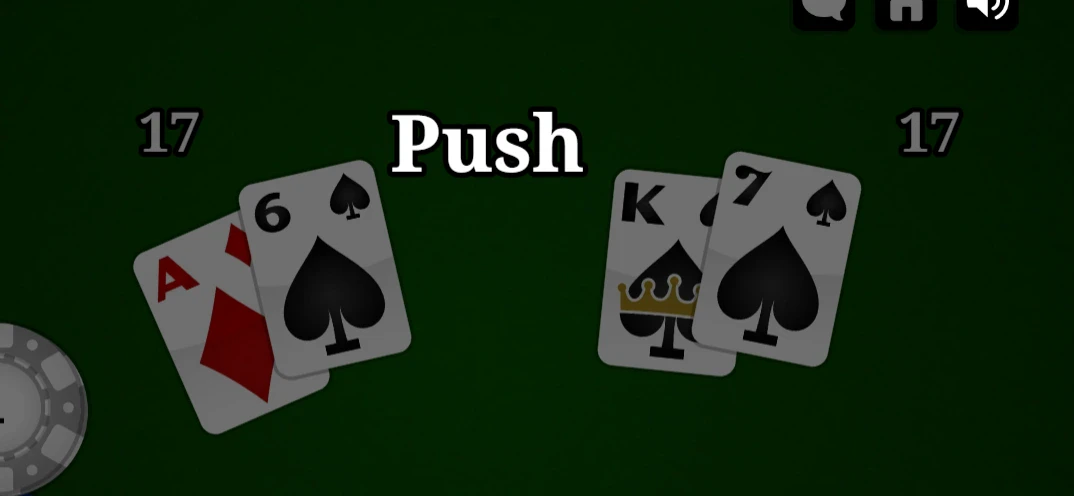
It's one thing to know when a Blackjack game is tied, but knowing what to do next is another. Generally speaking, especially if playing against a dealer at a multi-seat casino table, the push results in the wager being returned to the player. This signals the end of the hand and the next hand is an entirely new game. While many players will repeat the wager, you would also have the option to:
- Increase your wager for the next hand,
- Reduce your wager for the next hand,
- Or walk away from the table with your returned wager from the previous hand.
When playing casually with friends, there is an alternative option in which a tied game is essentially replayed (with new cards being dealt), meaning that the wager value stays unchanged. When playing in casinos, though, the above outcome of wagers being returned to players is used regardless of whether it's Classic Blackjack, European Blackjack or any other variant.
As far as your chip total is concerned, a tied hand delivers the same outcome as if it hadn't been played. So, contrary to the concerns of some new players, dealers do not have an edge caused by the prospect of a draw. Unlike some card games where you either win or lose, Blackjack generally offers three outcomes that are reflected financially as well as by the hand itself.
Understanding Blackjack Ties: Split Hands
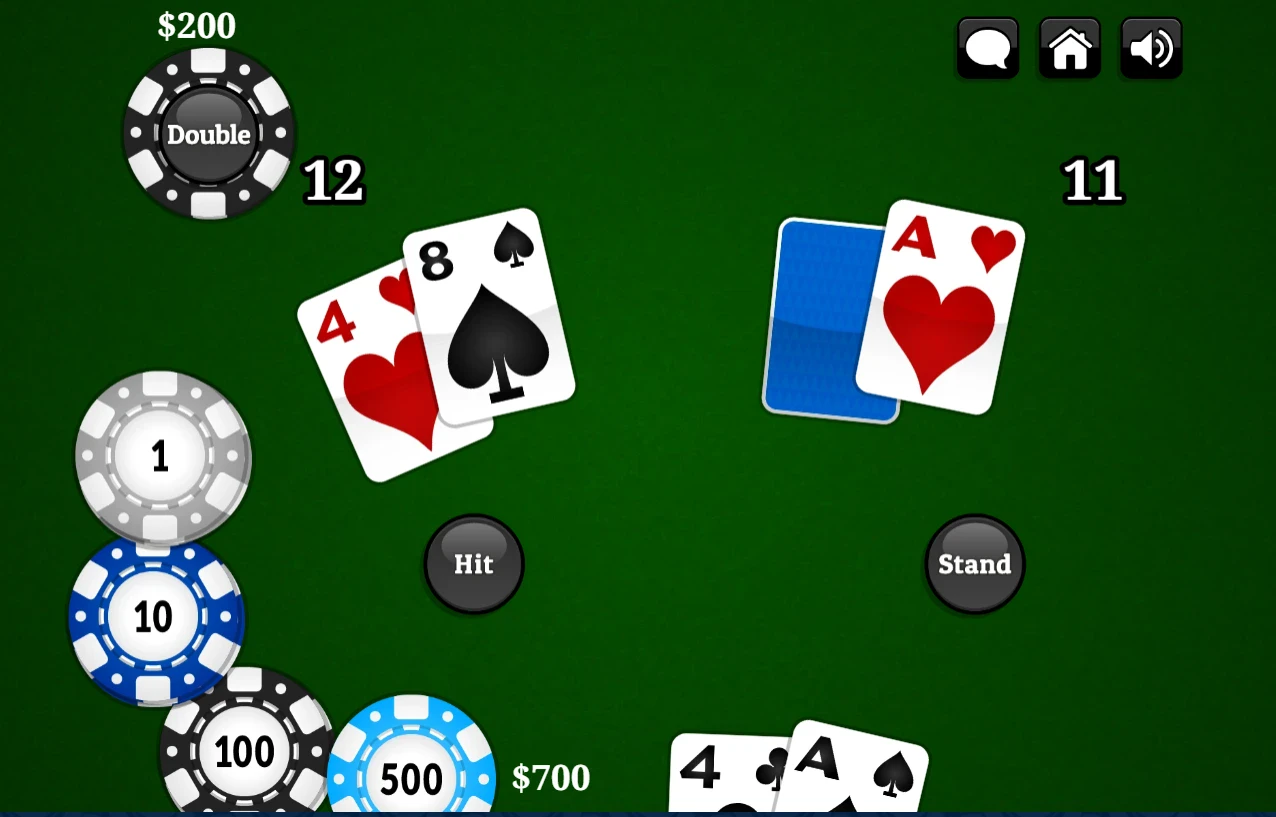
When your opening cards are a pair (such as two 8s), you also have the option to split. This creates two simultaneous hands, meaning you have to double your wager. If this happens you could potentially push on either or both hands:
- Hand 1 is a 19 (8 + Ace) and Hand 2 is 18 (8 + Jack) while the Dealer scores 19. Hand 1 is a push. Hand 2 is a loss. You lose one wager and return the other.
- Hand 1 is a 19 (8 + Ace) and Hand 2 is 18 (8 + Jack) while the Dealer scores 18. Hand 1 is a win. Hand 2 is a loss. You win one wager and return the other.
- Hand 1 is a 19 (8 + Ace) and Hand 2 is 18 (8 + Jack) while the Dealer scores 21. Both hands are losses. You lose both wagers.
- Hand 1 is a 19 (8 + Ace) and Hand 2 is 18 (8 + Jack) while the Dealer scores 17. Both hands are winners. You win both wagers.
Understanding Blackjack Ties: Both Players Bust
In addition to understanding pushes up to a score of 21, players may ask "what happens when the dealer busts too?".
A player busts when they hit a score of 22 or more. However, the dealer also busts if they exceed the score of 21. So, you may be wondering if this results in a draw, especially if you bust on the same score. Unfortunately, a player who busts will automatically lose the hand because they have made their move before the dealer. The outcomes are as follows:
- Player A hits 23 and Dealer hits 25. Player loses.
- Player A hits 26 and Dealer hits 22. Player loses.
- Player A hits 24 and Dealer hits 24. Player loses.
Dealers play their hand last, which is coupled with the fact that the player who busts loses regardless of the dealer's total to create a slight house edge.
What Happens if Blackjack Plays Against a 21?
A common source of confusion stems from when both players have 21, and many players will ask "What happens if one player hits Blackjack and the other hits 21 with three or more cards?".
In short, Blackjack is the strongest hand that a player can hit. So, it will beat any other hand, even if the opponent registers a score of 21. This rule is in place regardless of whether you are the dealer or the player. In other words:
- Player A hits Blackjack (Ace + 10 or face card) while the Dealer hits a non-Blackjack 21 (e.g. 8+6+7). Player A wins.
- Player A hits a non-Blackjack 21 (e.g. 9+2+Jack) while the Dealer hits Blackjack (Ace + 10 or face card). Dealer wins.
- Player A hits hits Blackjack (Ace + 10 or face card) while the Dealer also hits Blackjack (Ace + 10 or face card). Game is a tie or push.
It should also be noted that all cards with a value of 10 (10, Jack, Queen, or King) are deemed equal and will result in the player landing Blackjack. So, an Ace + King does not outweigh an Ace + Jack. If both players have Blackjack, the hand is tied irrespective of which cards are used.
What About a Five Card Charlie?
While Blackjack beats a non-Blackjack score of 21, all other scores are generally equal regardless of how many cards are drawn to make that score. So, the player's hand of 20 (Jack + 10) versus the dealer's hand of 20 (5 + 6 + 9) is a push. However, there is one other outcome to consider: the Five Card Charlie.
A Five Card Charlie, also known as a Five Card Trick, is when a player makes a score equal to 21 or less with five cards. An example would be a hand of 2 + 3 + 5 + 8 + Ace, which scores 19 if the Ace is used as a 1 rather than an 11. This type of hand is the second strongest available, beating everything other than Blackjack. As long as the dealer does not hit Blackjack, you win the hand:
- Player A hits a Five Card Charlie worth 18 while the Dealer hits 17. Player A wins.
- Player A hits a Five Card Charlie worth 19 while the Dealer hits Blackjack (Ace + 10 or face card). Dealer wins.
- Player A hits a Five Card Charlie worth 19 while the Dealer hits 19 (King + 9). Player A wins. NOT a draw.
- Player A hits a Five Card Charlie worth 19 while the Dealer hits 21 (King, 6 + 5). Player A wins. Not a loss.
While a Dealer could technically make a hand using five cards, the Five Card Charlie rule only applies to the player. This means you cannot draw a hand in which you create a Five Card Trick.
What Happens if You and Another Player Hit the Same Score?
One final point of consideration is when you have the same score as another player (not the dealer) at a table with multiple seats. Blackjack is just about you versus the dealer. Consequently, the scores of other players have no impact on the result of your hand, which includes if they tie the dealer. The only influence on the game is that both you and the dealer will be unable to draw the cards drawn by other players.
As far as winning, losing, or pushing is concerned, you only have to worry about how your score stacks up against the dealer's.